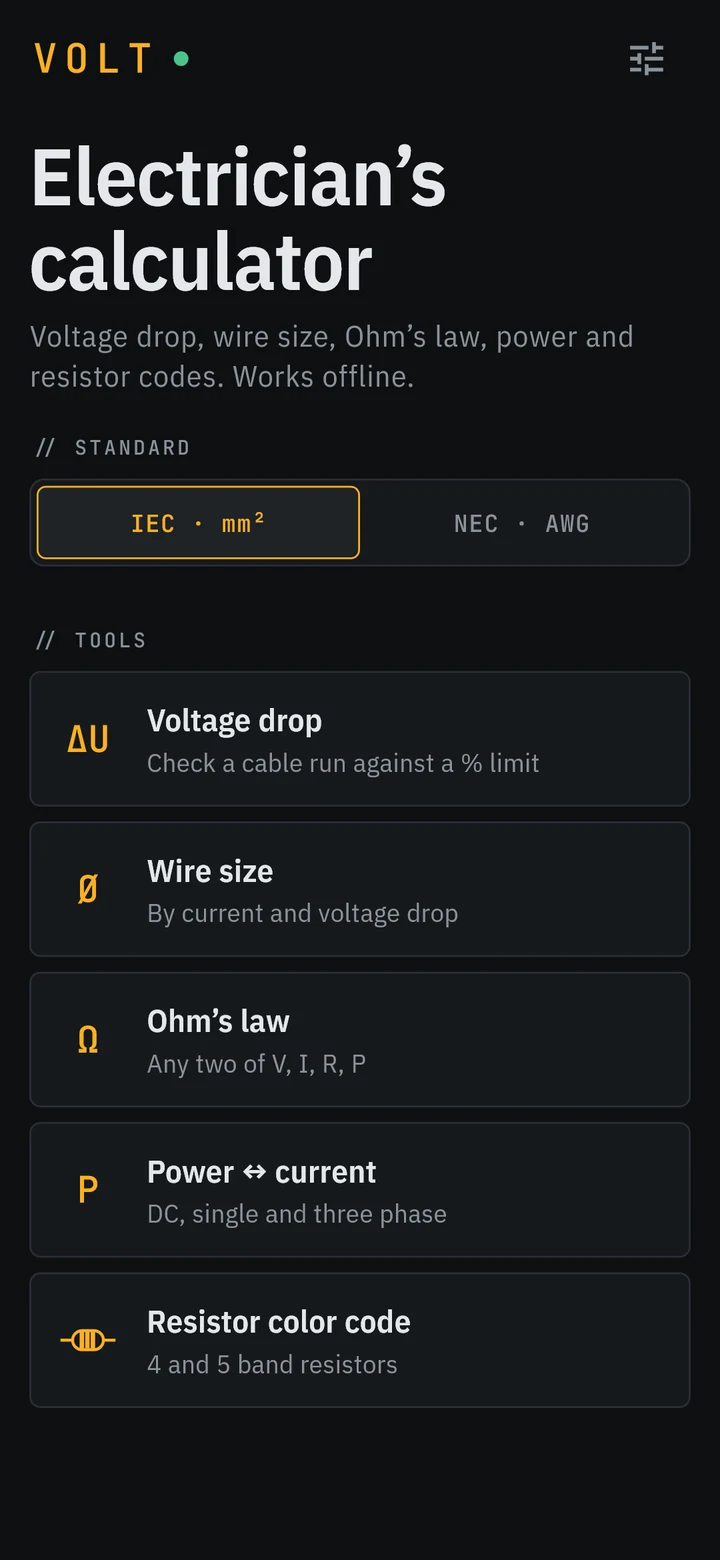
Tools
Five instruments for the jobs you calculate every week
| Tool | Input | Reading | |
|---|---|---|---|
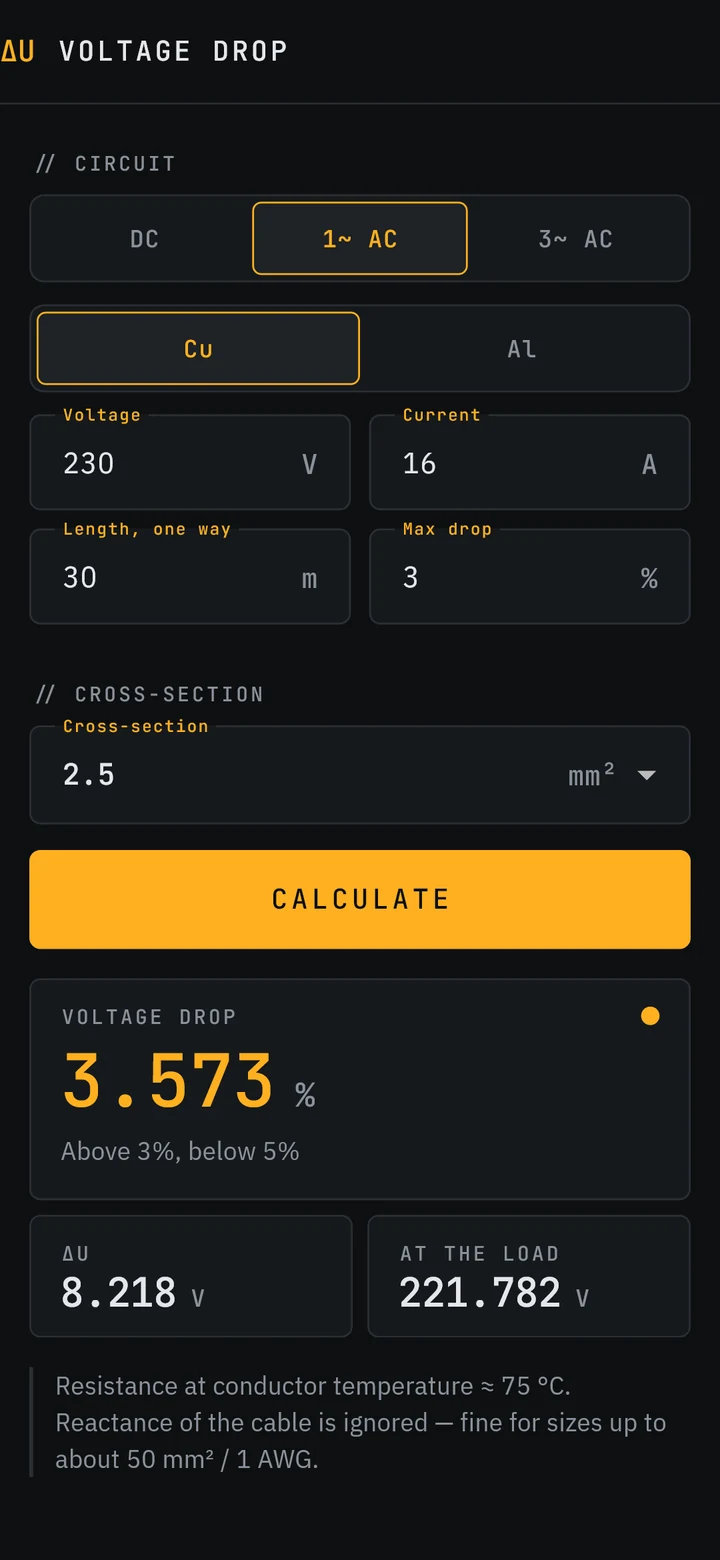
| ΔU | Voltage drop | System, Cu or Al, voltage, current, one-way length, cross-section, limit % | Drop in % and V, voltage at the load, green / amber / red against your limit |
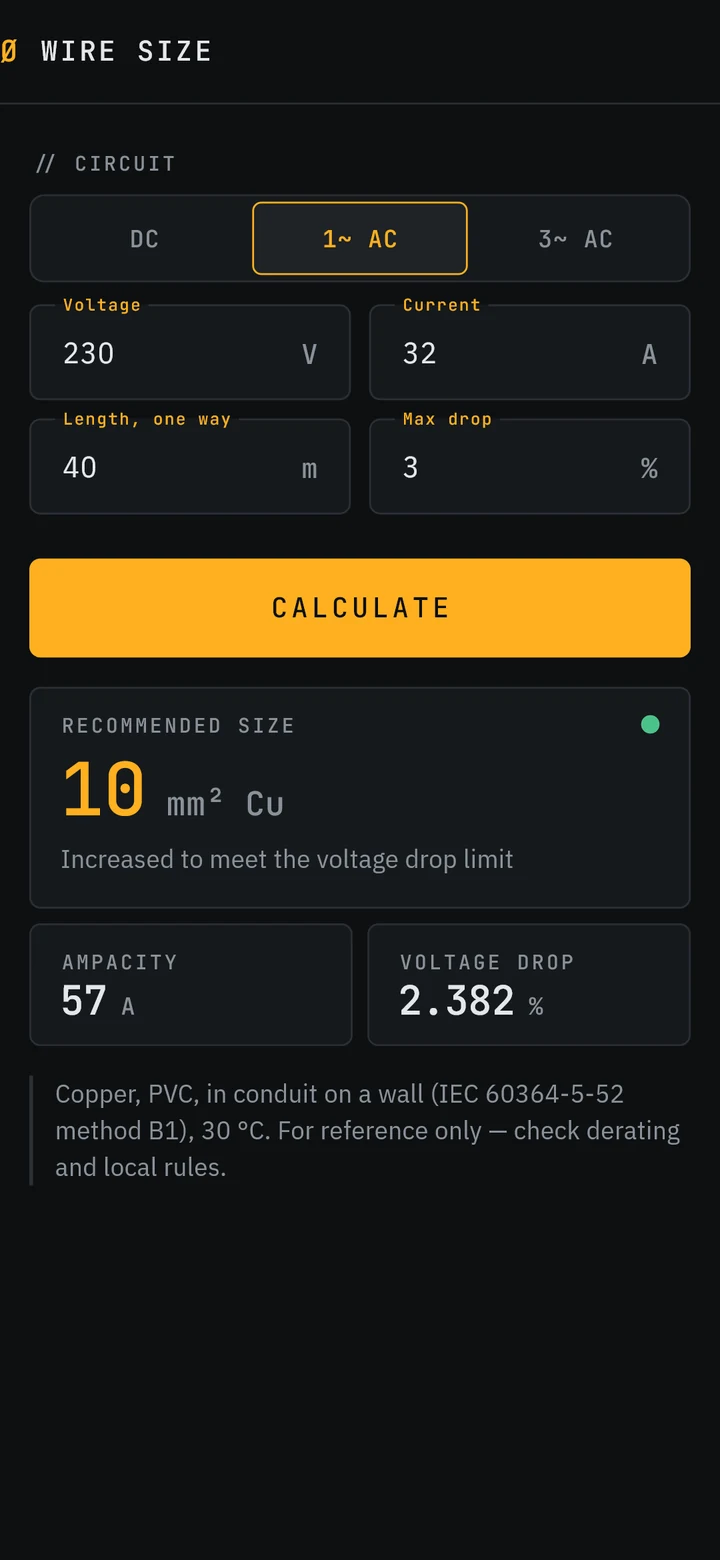
| Ø | Wire size | System, voltage, current, length, max drop % | Smallest copper size that passes both ampacity and drop — and which one limited it |
| Ω | Ohm’s law | Any two of V, I, R, P | The other two, with the given values marked |
| P | Power ↔ current | DC, 1~ or 3~, voltage, kW or A, cos φ | Current or active power, apparent power in kVA, horsepower |
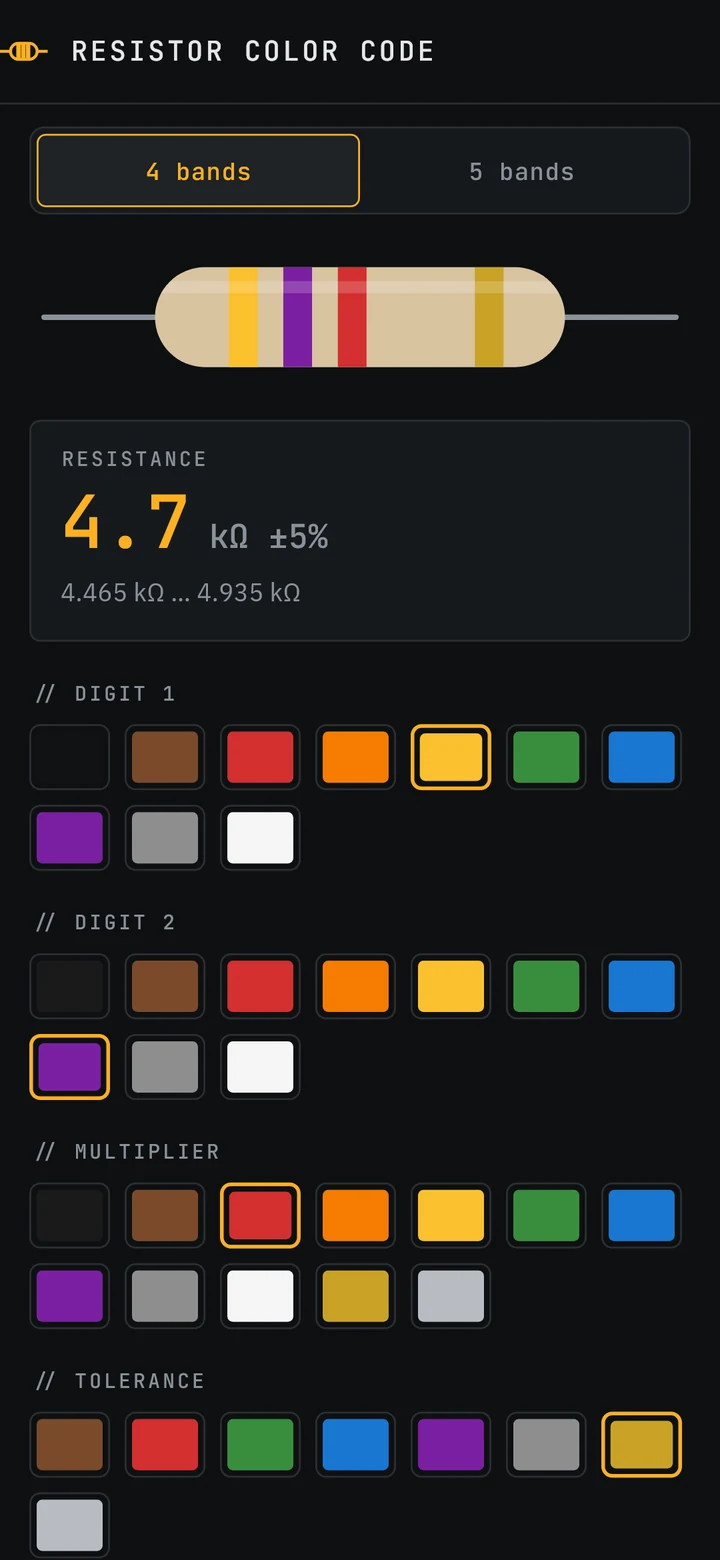
| R | Resistor color code | 4 or 5 bands, tapped on a drawn resistor | Value with kΩ / MΩ prefix, tolerance and min–max range |
Standards
Switch once. Every tool follows.
IEC
- Sizes
- 1.5 – 120 mm²
- Length
- meters
- Voltage
- 230 V · 400 V
- Ampacity
- IEC 60364-5-52, copper/PVC, method B1, 30 °C
NEC
- Sizes
- 14 AWG – 4/0
- Length
- feet
- Voltage
- 120 V · 208 V
- Ampacity
- NEC 310.16, 75 °C column, 240.4(D) limits for 14–10 AWG
Formulas
What’s under the readout
Drop · DC and single phase
ΔU = 2 · L · I · ρ / AL is the one-way length — the factor 2 covers the return conductor.
Drop · three phase
ΔU = √3 · L · I · ρ / APercent is taken against line-to-line voltage.
Resistivity at ≈ 75 °C
ρ Cu = 0.0214 · ρ Al = 0.0352Ω·mm²/m at conductor operating temperature — the same K values the NEC uses, so results lean safe.
Three-phase power
P = √3 · U · I · cos φApparent power S = √3 · U · I. One horsepower = 745.7 W.
Volt is a reference tool. Ampacity tables assume one installation method and ambient temperature; grouping, insulation and local code can change the answer. Check before you install.
Screens
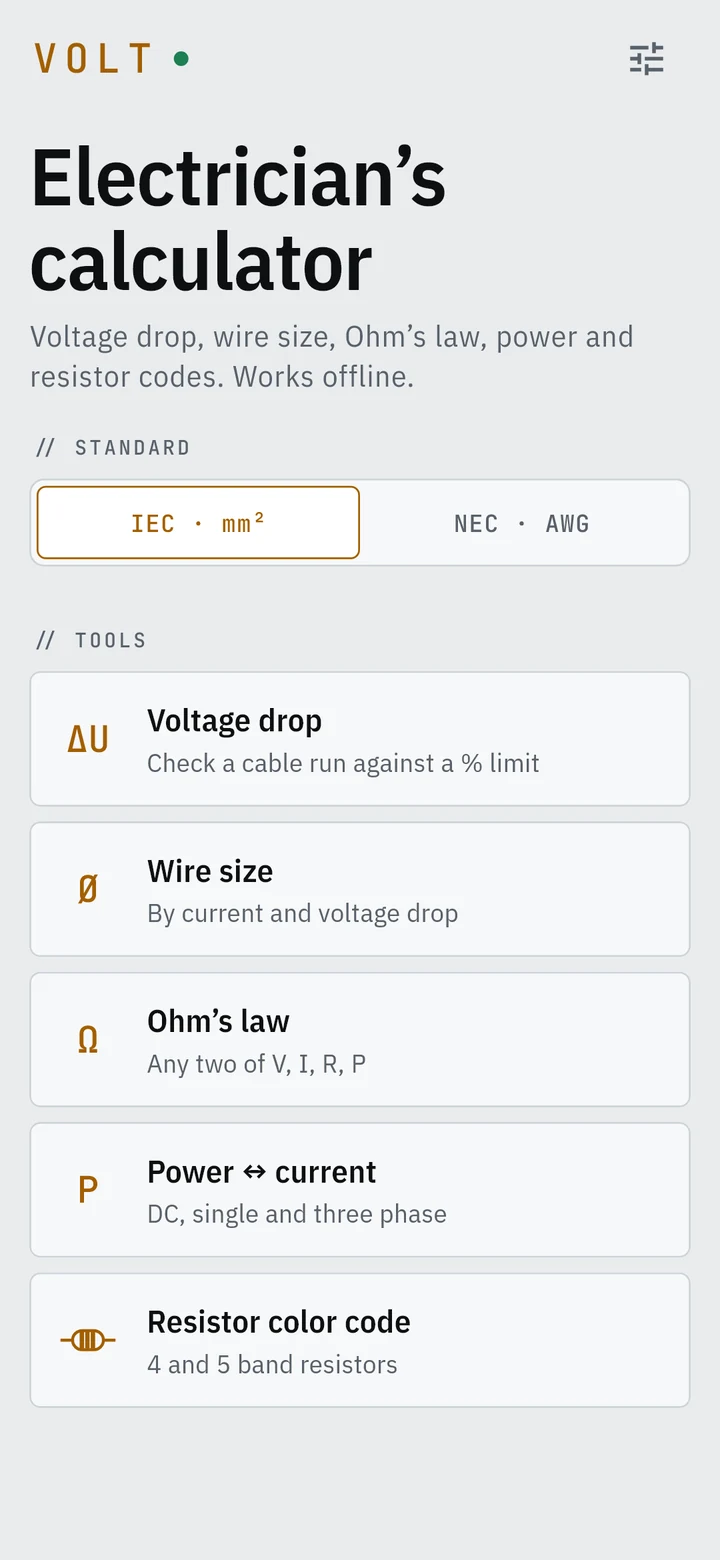
Dark or light. Readable in a basement.